I usually take the train to work. The final destination for the train is at the base of Loch Lomond. On its way, it passes through a place, with a name familiar to any crafter - Singer. Isaac Merritt Singer neither invented the sewing machine or came from Glasgow. So why is Singer here?
 Before industrialisation women were responsible for sewing the families' clothes, linens and reusing materials. The invention of the sewing machine speeded up this work. Household sewing machines also meant that this could be a source of extra income for the family, and gave women some independence. The first patent for a sewing machine was given to the British inventor, Thomas Saint in 1791, however a working model was never built.
 Isaac Merritt Singer was an American engineer, he founded his business in New York in 1851. Singer wanted to expand his business into the UK and chose Glasgow. A branch office opened in 1856 close Queen Street station, with parts imported from America. The popularity of Singer sewing machines led to the first Singer factory opening outside of the USA, on James Street in Bridgeton. Incidentally James street is about 5 minutes walk from where I start my train journey.
 Despite the Bridgeton factory, there were long waiting lists for owning a sewing machine. So Singer decided to open a larger factory, where all parts could be made on the one site. On 46 acres of old farm land at Kilbowie, just outside Clydebank, the largest sewing machine factory in the world opened in 1883. It was a very modern building, with sprinkler systems fitted, a 200ft clock tower towering over the plant, and recreation grounds for staff. An extra 2.5miles of railway track was added to link each department with the Glasgow to Helensburgh train line. At opening the factory employed 5000 people, with the workforce peaking in 1960 at 16,000. Singer at one point is reported to have made 80% of the worlds sewing machines. And during both World Wars the factory turned its production from sewing machines to munitions. It is even rumoured that the statue of liberty is modelled on Isaac’s beautiful wife Isabella Eugenie Boyer Singer.
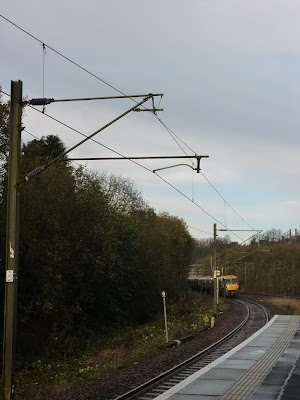 The Singer factory in Clydebank factory closed in June 1980. Singer permanently leaves its mark in Glasgow with the name of the train station remaining. Singer station is beyond the stop I get off, maybe one day I shall skip work and head off there on an adventure.
Today I am sharing samples that I wasn't initially happy with. Having been cast aside for a while, I tried adding something to them. Hopefully a change for the better. For once, less isn't more. Firstly green painted tyvek (a remnant from this), changed to blue and then metallic paints added.
 After a quick iron, I think it has transformed into a moth.
 A red and yellow silk painting sample, was machine stitched, and then black oil pastel, red ink and metallic paint added. Has it become a short circuit?
 A chocolate brown flower card, tries to become bronze with the help of acrylic paint.
 An ink sample, is covered with oil pastels, scratched into, flooded with red ink, and then the pastel removed. An alternative flag?
 It hasn't just been samples today, I have been in search of some Greek Art for UWA, more of that tomorrow. But for now, here is a friend I made on the way!
Yesterday was the fourth episode of The Genius of British Art on channel 4. Sir Roy Strong introduced landscape art, and discussed how land (and its ownership) is important in the English psyche. After all, an Englishman's home is his castle. I can understand this notion, as an English person living in Scotland, living in a flat is lovely, but I do dream of one day having my own flight of stairs and little garden (though probably not the white picket fence).
The program introduced me to Samuel Palmer (1805-1881), who was heavily influenced by Blake.
 Early Morning - Samuel Palmer
 The Magic Apple Tree - Samuel Palmer
 The Flock and Star - Samuel Palmer
Today another trip across to the capital. Firstly stop was Paws Here, a pet rescue centre in Morningside. Today was their open day, which meant we got to handle some very energetic rats, stroke a few rabbits and cuddle a gorgeous lady guinea pig (don't tell the boyz!). I did my good deed and donated a dozen guinea pig Christmas tree decorations to help with their fundraising. Who wouldn't want a gp on their tree at Xmas?
 Yarn lovers take note, Paws Here are having a on-line raffle with some great prizes: see ravelry. Lunch was spent surrounded by some pretty cool birdy prints from Pigeon Industries.
 At the City Art Centre there are currently two photography exhibitions, the first is from William Wegman. Family Combinations is all about his weimeraners, these silky dogs trust Wegman enough to allow him to contort and pose them for the camera. The pictures are comical, sometimes absurd and the films (including some made for Sesame Street) are hilarious. But then you wonder how these dogs were trained? Do they ever rebel against their master? And isn't it slightly odd to be dressing a dog in a dress?
The other exhibition is from Edward Weston. Weston used powerful black and white photography to give new ways of viewing things. These bold images distorted my initial comprehension. What I thought was a bronze statue turned out to be a pepper, engineering parts were actually shells and steps were in fact sand dunes.
Wandering along the Royal Mile you can not help but notice the amazing buildings surrounding you. The light was still good enough to catch a couple of pictures.

 Back at home, a quick practice at free motion embroidery. Using a scrap of lace that I had dyed, backed on felt, I attempted to outline the flowers, interestingly I think I prefer the back - though mind the birds nests!

 Before industrialisation women were responsible for sewing the families' clothes, linens and reusing materials. The invention of the sewing machine speeded up this work. Household sewing machines also meant that this could be a source of extra income for the family, and gave women some independence. The first patent for a sewing machine was given to the British inventor, Thomas Saint in 1791, however a working model was never built.
 Isaac Merritt Singer was an American engineer, he founded his business in New York in 1851. Singer wanted to expand his business into the UK and chose Glasgow. A branch office opened in 1856 close Queen Street station, with parts imported from America. The popularity of Singer sewing machines led to the first Singer factory opening outside of the USA, on James Street in Bridgeton. Incidentally James street is about 5 minutes walk from where I start my train journey.
 Despite the Bridgeton factory, there were long waiting lists for owning a sewing machine. So Singer decided to open a larger factory, where all parts could be made on the one site. On 46 acres of old farm land at Kilbowie, just outside Clydebank, the largest sewing machine factory in the world opened in 1883. It was a very modern building, with sprinkler systems fitted, a 200ft clock tower towering over the plant, and recreation grounds for staff. An extra 2.5miles of railway track was added to link each department with the Glasgow to Helensburgh train line. At opening the factory employed 5000 people, with the workforce peaking in 1960 at 16,000. Singer at one point is reported to have made 80% of the worlds sewing machines. And during both World Wars the factory turned its production from sewing machines to munitions. It is even rumoured that the statue of liberty is modelled on Isaac’s beautiful wife Isabella Eugenie Boyer Singer.
 The Singer factory in Clydebank factory closed in June 1980. Singer permanently leaves its mark in Glasgow with the name of the train station remaining. Singer station is beyond the stop I get off, maybe one day I shall skip work and head off there on an adventure.


