Tuesday, 15 March 2011
The Last Supper with Parrots?
Unfortunately the church were not too happy with this, and called Veronese in front of the Inquisition. The transcript for this still exists, and I can't help but chuckle at the thought of the Holy Office grilling Veronese on his painting. Although I am sure it can't have been much fun for him. Monty Python created a skit based on this very event.
The outcome for Veronese? He was ordered to improve and alter the painting within three months. Veronese did not do this, instead he changed the name of the painting to the Feast in the House of Levi. Veronese was a religious man, so was unlikely to have painted this to offend (interestingly Leonardo da Vinci who also painted an image of the Last Supper was apparently agnostic). Veronese's experience certainly raises questions about artistic license, and shows the power of the church at this time.
Tuesday, 11 January 2011
Giotto - The Lamentation of Christ
The fresco image is split in to two halves. On the bottom half you have Christ's body being held and surrounded by mourners. In the top half you have ten angels in the sky. In the top right corner, there is a lone tree on a rocky ridge, this moves down the painting to led you to where Christ's head is being cradled by the Virgin Mary. It is clear that Christ's body has just been taken down from the cross, yet this is not shown in the picture.
The arrangement of people in the scene is unusual, as the closest figures are two men with their backs facing the viewer. These help to indicate that Christ is encircled, people overlap and the image is not flat. A sense of depth is created in the picture, similar to that of a theatre stage. Religious figures are indicated by their halos. A crowd of mourners are cut from the frame on the left. All the characters display grief and sorrow, through their different facial expressions and their posture. It is said that Giotto visited funerals to watch people as they mourn.
Christ's body is being held above the ground by the mourners. This could be interpreted that his body had weight, like that of a mortal; or that his body is soon to be resurrected. His face is cradled by his mother Mary, similar to images of her cradling him as a child. Each person is individual, and you are able to tell who they are, for example Mary Magdalene is shown with red hair, touching his feet and John the Baptist is shown outstretching his arms in anguish. Light falls down on Christ's body, and highlighting John's robes.
The lone tree is bare of leaves, which could indicate death. Though as trees renew their leaves in spring, it could indicate the resurrection and eternal life. The tree could also be the the garden of Eden, where sin was first committed, and that Christ then dies for our sins. The bleakness of the background contrasts with the richness of the robes, the array of colours, and the detail of folds indicating the body shapes underneath. The angels are all painted with different postures and show foreshortening.
The Lamentation is an important piece of art, it moved pictures from being flat images, to those that create a sense of depth. Giotto draws the viewers eye to the bottom left of the picture (in contrast to the more traditional centre of a piece) by use of the mountain ridge line and the characters arrangement. The individual expressions of both the people on earth and the angels, highlight the real sense of emotion and anguish of the piece.
Monday, 3 January 2011
Cathedral sketches


And for the introverted creative types out there, a link to a great post.Sunday, 5 December 2010
Glagow Cathedral in the snow...


I particularly like the stained glass, and went animal spotting on the many panes.


The stained glass gives an ethereal feel to light. Behind the cathedral is the necropolis, where wealthy Victorians were buried. This city of the dead dominates the skyline.
The patron saint of Glasgow and is St Mungo and images of his alleged miracles are seen around the cathedral. They are remembered by the following rhyme: - Here is the bird that never flew
- Here is the tree that never grew
- Here is the bell that never rang
- Here is the fish that never swam

Saturday, 27 November 2010
What have the Romans ever done for us?
This time Roman art. My drawing skills are coming along, practice, practice, practice!


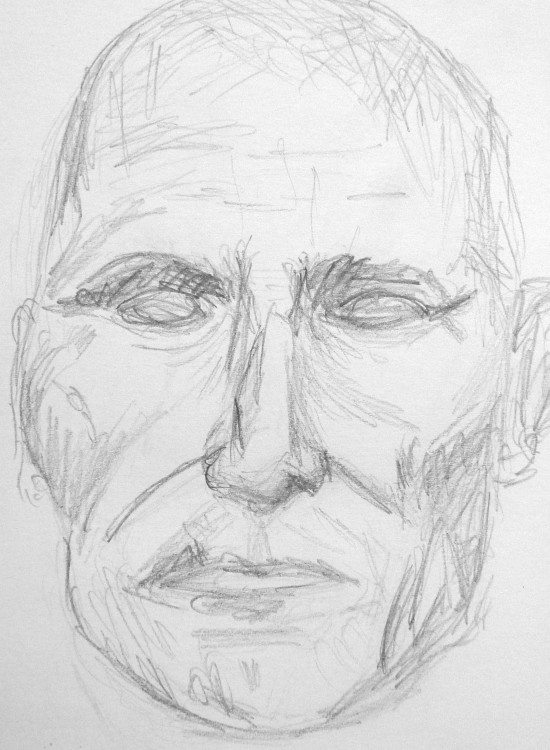
I did attempt to draw this lady - but it turned out like a bad Susan Boyle. Too bad to share here! And as for the question, what have the Romans ever done for us? Just ask Monty Python...
Tuesday, 16 November 2010
A neoclassical building...
Wednesday, 27 October 2010
It's all Greek to me...

Here are 5 facts that I didn't know about Ancient Greece:
- The columns in the Parthenon are not equally spaced or perfectly straight. The architects used optical refinements to compensate how our eyes view the structure from the hillside.
- Inside the Parthenon was a huge sculpture of Athena created by Phidias. Records describe it as being made from gold and ivory, reaching forty feet tall. It was occasionally taken outside the building for festivities!
- Although we see the statues as plain marble or brass, they would have been colourfully painted. Copper inlays were used on the lips and nipples, silver as eyelashes and glass inlaid for eyes.
- A statue of Aphrodite of Cnidus by Praxiteles is thought to be the very first life-size nude female sculpture in Greek culture. Her coy posture, concealing her groin with her hand, created an image of a the female nude that was to continue for centuries in Western art.
- The word 'barbarian' comes from Ancient Greek. To Greek ears anyone who didn't speak the same language apparently made a bar, bar sound (probably like our blah, blah today) and was therefore given the term a barbarian!
My research so far has been from A World History of Art by Hugh Honour and John Flemming, Greek Art by John Boardman, and a trip to the Burrell collection to see some pieces firsthand. One of my favourite pieces at the Burrell was a jug for pouring wine, with grazing deer circling round. It is amazing to think that this has survived whole.
Monday, 18 October 2010
Quick! Urgent educational materials!!!!
Well, I have now dissected my package, ordered new books (thank you Amazon marketplace) and spent some time trying to get to grips with the new OCA student website. Actual learning time = none. Though I did managed to find a music video that might possibly be coursework...
Yesterday I was filling my sketchbook with work on the theme of layers. Firstly layers of metallic paint and pen over an ink background.
Skeleton leaves layered over watercolour bird silhouettes and a twee bird stamp.
And finally metallic paints over an ink wash, over crayon and oil pastel.