Showing posts with label art history. Show all posts

Thursday, 5 May 2011

Flemish Baroque Guinea Pigs!

For my UWA I needed to look at some northern baroque art. Off I went on a sunny day to Kelvingrove which has a large collection of Dutch art.
I wandered around trying to pick a painting to look at in detail. There are wonderful pieces from Rembrandt, Ruysch and de Lairesse to name a few. However it was a collaboration piece by Peter Paul Rubens and Jan Brueghel that caught my eye.
Rubens and Brueghel - Nature adorned by the three Graces, 1615
Kelvingrove Art Gallery and Museum, Glasgow

A classical inspired statue of a multi-breasted mother nature, surrounded by mythical characters and a huge garland of fruit and vegetables. Standing in front of the painting I noted the variety of produce - pumpkins, peaches, plums, artichokes, cabbages, carrots, turnips, wheat, apples, pears, lemons, oranges, cherries etc. Also painted are a monkey, a squirrel, a parrot and in the bottom right hand corner two guinea pigs! Firstly I wasn't too sure of it was guinea pigs, but there are definitely no tails, and the body shape is right, and they are sitting eating podded peas.
The painting is from 1615, at this time Amsterdam was a wealthy port. Guinea pigs were first brought to Europe by traders after the discovery of the Americas. They were popular exotic pets for the upper classes, a sign of fruitfulness and apparently even Elizabeth I had a pet guinea pig. I should point out that Brueghel would have painted the guinea pigs (rather than Rubens - who painted the figures), and apparently Brueghel has painted pairs of guinea pigs in other paintings too!
Currently we are without guinea pigs, as poor Oscar had a seizure and passed away. But it seems even when I go to the gallery I am automatically drawn to them!

Monday, 28 March 2011

The Spreull Family and their knitted stockings

Every time I go to the Hunterian Art Gallery I am drawn to a painting by David Allan of The Spreull Family.
David Allan - The Spreull Family, 1793
Hunterian Museum and Art Gallery, Glasgow
Not because of the size (though at 117cm x 154cm it is huge), nor the detailing of the landscape, nor the expressions on the sitters faces, nor the little girl sitting on the floor staring into the distance, not even the gun dog on the right. I am drawn to this painting because the older lady has in her lap on double pointed knitting needles the start of some socks! Actually they are probably stockings, as apparently socks were rarely worn in the 18th century.

The artist David Allan (1744 - 1796) studied at the Foulis academy in Glasgow. Allan spent ten years living and painting in Italy, before returning, firstly to London and then back to Scotland. He became renowned for his genre paintings or conversation pieces, usually of families in informal settings (such as this painting). The family were the Spreull family, the father is James, graduate of Glasgow University, City Chamberlain and Superintendent of the Clyde. With his bright red hunting jacket, the vast landscape and size of the painting, this is all about James showing off his wealth and power. His wife Margaret (McCall) sits with their three eldest children (records show that they went on to have ten children in total). And to the very left of the picture, looking rather sternly, with knitting in her lap is Hannah (Park), James's mother.

Stockings were worn by everyone and without the advent of lyrca or nylon, they were made to fit the leg, narrower at the knee and ankle, and wider at the calf and thigh. Very poor people may have had stockings cut from woven cloth, rather than knitted. These would not have stretched very well, and may have been uncomfortable, so knitted stockings were preferable. Stockings could be machine knitted, as a stocking frame had been invented in 1589 by William Lee. The story is that Lee invented it to get revenge on his girlfriend who preferred to spend her time knitting rather than attending to him! By the mid-18th century machine knitted stockings were commonplace. So much so that hand knitters of stockings would, despite knitting in the round, imitate a seam by adding a line of purl stitches. Usual stitches for stockings were stockinette stitch (I assume this is were it gets its name from) or 1x or 2x rib. Fancy 'clocks' (patterns or motifs) were knitted by use of purl stitches or embroidered on to the finished stockings. I wonder what Hannah's finished stockings were like? And was she just desperate to get back to her knitting rather than posing for a painting? Note: for an 18th century stocking pattern see here.

Tuesday, 15 March 2011

The Last Supper with Parrots?

Imagine a Last Supper with parrots, buffoons, dogs, a nose bleed, drunkards and German soldiers. This would have certainly made the event more lively. Paolo Veronese (1528-1588) painted a huge canvas (17 x 42 feet) displaying just this.
Paolo Veronese - Last Supper / Feast in the House of Levi
Unfortunately the church were not too happy with this, and called Veronese in front of the Inquisition. The transcript for this still exists, and I can't help but chuckle at the thought of the Holy Office grilling Veronese on his painting. Although I am sure it can't have been much fun for him. Monty Python created a skit based on this very event.
The outcome for Veronese? He was ordered to improve and alter the painting within three months. Veronese did not do this, instead he changed the name of the painting to the Feast in the House of Levi. Veronese was a religious man, so was unlikely to have painted this to offend (interestingly Leonardo da Vinci who also painted an image of the Last Supper was apparently agnostic). Veronese's experience certainly raises questions about artistic license, and shows the power of the church at this time.

Tuesday, 11 January 2011

Giotto - The Lamentation of Christ

As part of my UWA I have been annotating images. My annotations have now progressed to form paragraphs! Albeit small paragraphs, but hey ho - got to start some where. I am currently studying the early Renaissance, and here is my first text...

Giotto - The Lamentation of Christ c. 1305 (fresco)
Scrovegni (Arena) Chapel, Padua, Italy

The fresco image is split in to two halves. On the bottom half you have Christ's body being held and surrounded by mourners. In the top half you have ten angels in the sky. In the top right corner, there is a lone tree on a rocky ridge, this moves down the painting to led you to where Christ's head is being cradled by the Virgin Mary. It is clear that Christ's body has just been taken down from the cross, yet this is not shown in the picture.

The arrangement of people in the scene is unusual, as the closest figures are two men with their backs facing the viewer. These help to indicate that Christ is encircled, people overlap and the image is not flat. A sense of depth is created in the picture, similar to that of a theatre stage. Religious figures are indicated by their halos. A crowd of mourners are cut from the frame on the left. All the characters display grief and sorrow, through their different facial expressions and their posture. It is said that Giotto visited funerals to watch people as they mourn.

Christ's body is being held above the ground by the mourners. This could be interpreted that his body had weight, like that of a mortal; or that his body is soon to be resurrected. His face is cradled by his mother Mary, similar to images of her cradling him as a child. Each person is individual, and you are able to tell who they are, for example Mary Magdalene is shown with red hair, touching his feet and John the Baptist is shown outstretching his arms in anguish. Light falls down on Christ's body, and highlighting John's robes.

The lone tree is bare of leaves, which could indicate death. Though as trees renew their leaves in spring, it could indicate the resurrection and eternal life. The tree could also be the the garden of Eden, where sin was first committed, and that Christ then dies for our sins. The bleakness of the background contrasts with the richness of the robes, the array of colours, and the detail of folds indicating the body shapes underneath. The angels are all painted with different postures and show foreshortening.

The Lamentation is an important piece of art, it moved pictures from being flat images, to those that create a sense of depth. Giotto draws the viewers eye to the bottom left of the picture (in contrast to the more traditional centre of a piece) by use of the mountain ridge line and the characters arrangement. The individual expressions of both the people on earth and the angels, highlight the real sense of emotion and anguish of the piece.

Saturday, 27 November 2010

What have the Romans ever done for us?

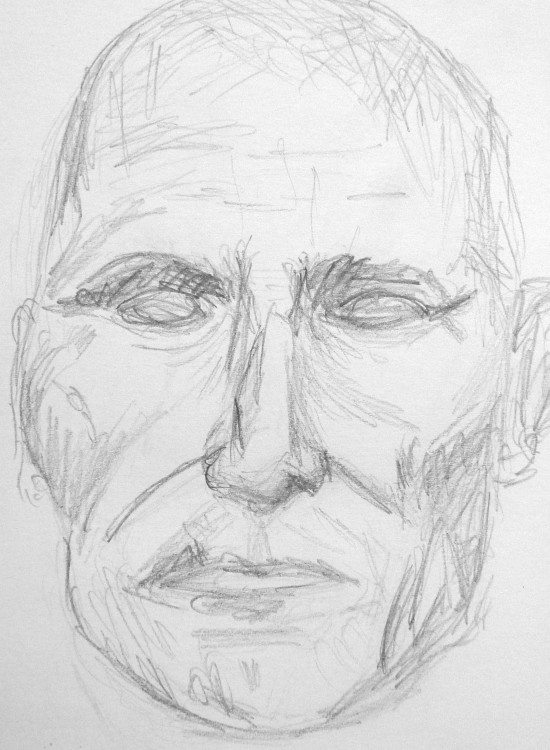
Back to the Burrell for more sketching.
This time Roman art. My drawing skills are coming along, practice, practice, practice!
I did attempt to draw this lady - but it turned out like a bad Susan Boyle. Too bad to share here!

And as for the question, what have the Romans ever done for us? Just ask Monty Python...

Thursday, 11 November 2010

Remembrance Day...

Corn Poppy Girl and The Quince Tree today feature my favourite war poems. Reading Dulce et Decorum est always makes me shiver. This week on the Genius of British Art, Jon Snow looked at war art. These images are haunting.

Two Sleepers - Henry Moore

We are a making a new world - Paul Nash

Column on the March - Richard Nevinson

Morning after the Blitz - Henry Moore

War pictures - Richard Nevinson
Wishing you all peace.

Monday, 25 October 2010

Dreamscapes and doodles...

Yesterday was the fourth episode of The Genius of British Art on channel 4. Sir Roy Strong introduced landscape art, and discussed how land (and its ownership) is important in the English psyche. After all, an Englishman's home is his castle. I can understand this notion, as an English person living in Scotland, living in a flat is lovely, but I do dream of one day having my own flight of stairs and little garden (though probably not the white picket fence).

The program introduced me to Samuel Palmer (1805-1881), who was heavily influenced by Blake.
Early Morning - Samuel Palmer
Beautiful intricate dreamscapes, secret natural worlds, full of mystique.
The Magic Apple Tree - Samuel Palmer
Unfortunately Palmer was largely forgotten after his death, and much of his work was destroyed by his son. This makes Palmer's work all the more mystical.
The Flock and Star - Samuel Palmer
Meanwhile I was been making my sewing machine angry, by stitching into some lightly painted watercolour paper. I like the delicate doodles of stitch, and how shadows catch the loose threads.

Friday, 22 October 2010

Rage against the history machine

Long ago I went to Powell's. Powell's is a maze of rooms stacked high with books, situated in an entire block in Portland. You can (and we did) spend hours in Powells, justifying any excess baggage allowance that we may face. One of my purchases there was The Guerrilla Girls' Bedside Companion to the History of Western Art. A perfect introduction to UWA (albeit one that isn't on the syllabus).
Women have been largely written out of art history, so it was great to read a book that actually celebrates women who have pushed boundaries within art. The book has some jarring quotations, such as the following from Renoir: "The woman artist is merely ridiculous, but I am in favour of the female singer and dancer". Check out the Guerrilla Girls website for how to get involved. Reading these horrors made me quite angry. I used a page in my sketchbook as an outlet for my rage.

Wednesday, 26 May 2010

The Glasgow Boys

Sunday was super sunny here in Glasgow, so perfect for a stroll in the west end to Kelvingrove to check out the Pioneering Painters: The Glasgow Boys 1880-1900.
The Glasgow Boys were not all from the city, but all had connections. In the early years they often headed to the country for the summer, immersing themselves in village life, making sketches and small paintings. In the winter they would head back to their studios in the city to complete their paintings. They were not afraid of depicting bleak funeral landscapes, workers in the fields and children at play. Later summers spent in France would result in paintings of fine ladies at rest. Japan placed a huge influence, with Henry and Hornel managing to spend over a year there (although unfortunately most of Henry's work from the trip was ruined in transit). I really enjoyed Guthrie's pastels and Melville's bright watercolours. And my special favourite, following my bird fascination is Crawhall's the white drake.

A trip the the west end could not be complete without a wander round welcome home & some delicious vegan food from the 78.

Tuesday, 9 February 2010

Yarn bombing isms...

Due to an IT hiccup, brain ache and a couple of photos sneaking into the wrong folder, I'd completely forgotten all about this yarn bombing I seen last September in Davie Village Community Gardens, Vancouver.
This yarn bombing had obviously survived the elements! This lovely knitted wall is apparently the work of Jessica Glesby. Yesterday whilst wasting my time (I mean being 'creative') on Craftster, I saw a new addition to this very garden from WooWork. Raining cats and dogs quite literally!
In between all this internet browsing I have finished reading one of my Christmas books ...isms: Understanding Art. As someone with aspirations to next study art history, this is a fantastic book. This book does not pretend to be ultimate art history resource. Each movement is given a 2 page spread with a definition, key words, artists and key pieces associated to each isms. A great book to go back to time and time again. I'll admit there were quite a few isms that I wasn't aware of!